Rugby Tactics and Strategy: A Practical Coaching Guide
Give your team a clear direction without taking decisions away from the players
Rugby is technically demanding, but it is also a game of tactical decisions and strategic choices. Strategy gives the team a direction. Tactics help the players respond to what is actually happening in front of them. A clear rugby game model should connect both levels through principles and shared reference points that players can use on the field.
This guide is written primarily for rugby coaches in the United Kingdom and the United States, while remaining relevant to club, school, college and academy environments across Ireland, Canada, Australia, New Zealand and South Africa.
The direction prepared before the match: where you want to play, which match-ups you want to create and how you intend to manage territory, possession and pressure.
The decisions made in response to the real picture: the defensive shape, field position, score, available space and behaviour of the opposition.
The shared principles and reference points that help fifteen players recognise the same situation and make connected decisions as a team.
These definitions can become complicated very quickly. I prefer to keep them useful for coaches: a playing system should give players shared reference points, not pre-program every decision.
Make the 1-3-3-1 Work
How to Build a Rugby Game Model Players Can Actually Use
A rugby game model connects the way a team wants to attack, defend, kick, manage transitions and restart the game. It should reflect the players available, the coaching principles, the level of competition and the amount of training time the squad actually has.
The team’s long-term framework
The game model provides the principles and shared language used throughout the season. It explains how the different parts of the game connect.
- Built around the strengths of the squad
- Used across training sessions and matches
- Connects attack, defence and transition
- Evolves as the players develop
The priorities for one specific match
The game plan adapts the wider model to an opponent, the weather, field position or a particular tactical problem expected during the match.
- Targets specific opposition weaknesses
- Defines territorial and tactical priorities
- Can change according to the score
- Should remain familiar to the players
A community club in England, an academy side in Ireland or a high school or college rugby program in the USA cannot simply reproduce everything seen in a professional match. The useful question is not only “What are the professionals doing?” but “What can our players understand, repeat and adapt when the pressure increases?”
Six Questions Every Rugby Coaching Staff Should Answer
The document itself can be simple. What matters is whether the coaches and players can answer the same essential questions.
Which attacking principles best suit the qualities of our players?
How do we create momentum and keep the defence under pressure?
How do our scrum, lineout and restart plays connect with phase play?
When do we carry, pass, kick or play back against the defensive movement?
How do we organise our defence and rebuild it after each breakdown?
Which decisions belong to the system, and which must remain with the players?
What Rugby Coaches and Directors Say
Here are a few testimonials from coaches and rugby directors who have taken our courses. Some coaches, particularly those working at higher levels, have asked not to be identified publicly.




Serge Collinet
“Extremely useful — even essential — for coaching.”
Charles is an expert who shares the knowledge and practical understanding that coaches need every day to maximise their teams’ potential and improve their ability to develop players. These resources can also evolve over time. Congratulations on this tremendous body of work and on your contribution to our game.
Name withheld at the coach’s request
A Fresh Perspective on Rugby Coaching
Up Rugby approaches attacking and defensive systems from a different angle, helping coaches understand the details that often make the difference on the pitch. Through clear explanations, video analysis and adaptable resources, each course provides practical ideas that coaches can integrate into their own game model.
Bakary Soumahoro
A very good course, clearly explained and supported by video examples. Charles is available to answer questions and provide further detail when required.
Thank you. I will definitely be back for more courses.
Valentin Caillaux
Relevant and effective content.
Working within a departmental rugby committee while also coaching in Fédérale 1, Charles’s courses have helped me continue developing as a coach and improve my understanding and analysis of the game.
Thank you again, Charles. I strongly recommend Up Rugby’s courses to coaches at every level, from professional and national divisions to regional rugby.
Adrien Renault
An excellent course.
We already had some general, experience-based ideas about attacking structures, particularly the 1-3-3-1. However, the depth and precision of the analysis enabled us to improve both our understanding and the accuracy of our approach.
The course also provides excellent tools, including video analysis and PowerPoint presentations, for both coaches and players. I highly recommend it. Well done, Charles!
Rugby Set Plays Must Prepare More Than the First Pass
Scrums, lineouts and restarts provide some of the clearest starting pictures in rugby. Whether you call it a launch play, strike play or set play, its purpose should go beyond moving the ball from one player to another. A useful launch must create the conditions for what happens next.
Identify the available space, defensive numbers, backfield positioning and most favourable match-ups.
Use movement, passing options and credible threats to influence how defenders move and connect.
Anticipate where the first ruck is likely to form and which players will secure or play away from it.
Reconnect the launch with the wider attacking system instead of allowing the team to become disorganised.
A Launch Play Needs a Tactical Purpose
Coaches can collect dozens of scrum and lineout moves, but the number of combinations is not what makes a team tactically strong. Each movement should answer a problem: create quick ball, attack a weak shoulder, move a particular defender, gain territory or place the team in a better position for the following phase.
A set play does not need to produce a clean line break to be successful. If it creates front-foot ball, forces the defence to retreat and gives the attack several credible options on the next phase, it may already have achieved its strategic objective.
The tactical responsibility then returns to the players. If the expected defensive picture changes, the scrum-half, fly-half and other decision-makers must be able to adapt rather than complete the original movement simply because it was drawn on the whiteboard.
Scrum Strategy
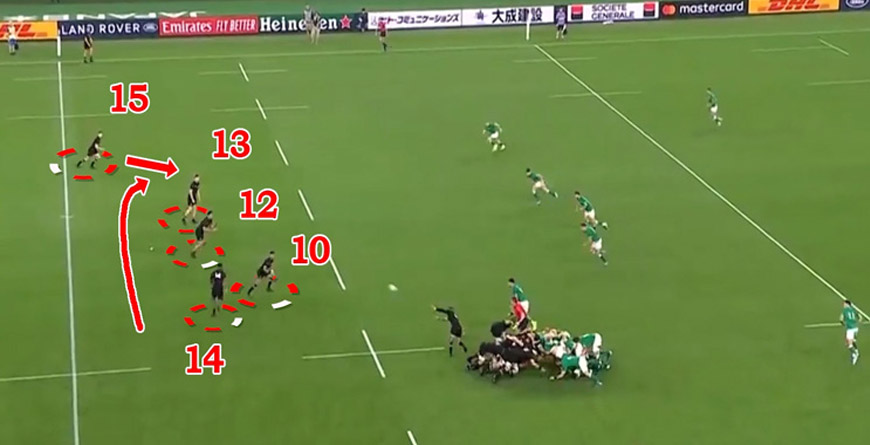
A scrum creates a relatively predictable distribution of forwards and backs. This gives the attack an opportunity to target a specific area while preparing the next phase.
- Identify the space available around the first receiver
- Decide where the first ruck should be created
- Anticipate which forwards become available next
- Connect the launch with the wider attacking shape
Lineout Strategy
The lineout can create several different pictures through the number of players involved, the threat of the maul and the movement before or after possession is won.
- Use the maul threat to influence defenders
- Connect forwards and backs around the same objective
- Prepare options on both sides of the lineout
- Plan the distribution after the first breakdown
Restarts and Kick Receipts
Restarts are less static, but they still require clear tactical organisation. Players must secure possession, identify pressure and decide how quickly the team can move into its preferred shape.
- Clarify the roles around the catcher
- Protect possession under pressure
- Choose between an exit and a counter-attack
- Rebuild width and depth efficiently
Before Adding a Set Play to Your Game Plan, Ask:
- Which defensive behaviour are we trying to provoke?
- Which space or match-up are we attempting to attack?
- Where is the first breakdown likely to form?
- Who will be available to play the following phase?
- What can the decision-makers change if the picture is different?
- How will the team recover its attacking structure?
The launch is only the beginning. Players also need clear reference points for their distribution after the scrum, lineout or restart. This connection is developed further in the guide to 1-3-3-1 rugby pod distribution .
Build a Smarter Ruck Defence
Your 9 and 10 Cannot Manage a Game They Have Not Been Taught to Read
Coaches often expect the scrum-half and fly-half to control tempo, territory and attacking direction while giving them the same tactical preparation as every other player. Dedicated half-back coaching should therefore be part of the wider rugby training programme.
The solution is not to make the 9 and 10 responsible for every decision. It is to give them a clear understanding of the game model, the language used by the team and the situations in which the original game plan may need to change.
They must also remain connected. A scrum-half who plays quickly without reading the attacking shape can remove options. A fly-half who demands the ball without understanding the quality of possession may receive it under pressure with no useful solution.
Connect the Breakdown with the Attack
The scrum-half sees the speed of possession and the organisation closest to the ball.
- Assess quick ball, slow ball and defensive pressure
- Communicate with forwards before the ball is available
- Identify numbers on both sides of the breakdown
- Control the timing and accuracy of the next phase
Connect the Shape with the Available Space
The fly-half reads the wider defensive picture and connects the first attacking line with the space beyond it.
- Identify line speed, spacing and backfield coverage
- Manage width, depth and attacking direction
- Choose between carrying, passing and kicking options
- Communicate early with forwards and outside backs
Train the Decision, Not Only the Pass
Technical work remains essential, but passing repetitions alone will not prepare the half-backs to manage a changing match situation.
Clarify the team language, the preferred options and the role of each player around the decision.
Vary ruck speed, defensive numbers, line speed and the position of the available space.
Discuss what the players saw and why they selected one option rather than another.
When Should Young Rugby Players Learn Tactics and Attacking Systems?
Young players make tactical decisions long before they learn a formal playing system. Every time they identify space, choose between passing and carrying or adjust a support line, they are already learning to read the game.
The real question is not when tactical learning begins. It is when the coach should introduce more detailed collective organisation without reducing creativity, individual skills or decision-making.
Explore the Game
Training should create frequent opportunities to move, handle the ball, identify space and solve simple problems.
- Passing, catching and evasion
- Support before and after contact
- Scanning space and defenders
- Small-sided, game-based activities
Connect Simple Principles
Players can begin to use shared rules without being locked into fixed pods or permanent field positions.
- Preserve attacking width
- Recognise numerical advantages
- Communicate around the ball
- Adapt support to the situation
Introduce a Clearer Game Model
In my experience, this is often the right stage to introduce a more complete attacking and defensive framework.
- Distribution from set piece
- Shared attacking reference points
- More detailed 9–10 decision-making
- Links between tactics and the game plan
Age-group terminology differs between the UK, Ireland and the United States, and players do not all develop at the same speed. The level of structure should therefore depend on their readiness, experience and training environment—not only the age printed beside the team name.
How to Choose the Right Rugby Attacking System for Your Team
A rugby attacking system—sometimes described as an offensive system by coaches in the USA—organises how players occupy the pitch and rebuild their shape after each breakdown. It provides useful positions from which decisions can be made, but it should never make every decision for the players.
The objective is not to copy the system used by the latest successful professional team. It is to choose a framework your players can understand, maintain under pressure and adapt when the original attacking picture disappears.
Clear Central Reference Points
The eight forwards are generally organised into two central pods of three, with one forward operating towards each edge.
- Maintains width across the pitch
- Creates two clear central forward groups
- Connects naturally with several playmakers
- Can be practical for community and amateur rugby
- Still requires effective pod rotation and communication
Strong Edge Connections
The forwards are broadly distributed with four through the middle and two operating towards each edge of the pitch.
- Creates attacking presence on both edges
- Can offer excellent width and continuity
- Requires mobile and technically capable forwards
- Places greater demands on collective understanding
- Must match the fitness and experience of the squad
Choose the System Around Your Players
Before selecting a 1-3-3-1, 2-4-2 or another attacking structure, assess the reality of your coaching environment.
In my view, the 1-3-3-1 is often easier to introduce in community, school, college and amateur rugby because its central pods provide clear reference points. That does not make it automatically better. A simple structure understood by the players will always be more useful than a fashionable system that disappears after two phases.
For a more detailed comparison of the 1-3-3-1, 2-4-2 and forward pod structures, read the guide to rugby attacking systems, pods, shape and defence .
Support Play Is Essential—but It Is Not a Complete Attacking System
Before players can operate inside a 1-3-3-1, 2-4-2 or any other rugby attacking shape, they must understand how to support the ball carrier, occupy space and return to useful positions. These behaviours are common to every game model.
Provide passing, continuity and breakdown options around the ball carrier.
Keep enough separation to threaten several areas of the defensive line.
Return from the previous action and become useful again instead of following the ball.
Adjust the running line and support role according to space, defenders and ruck speed.
Support play can be developed without introducing fixed pods or permanent positions. This makes it particularly valuable in youth rugby, where players need to explore different roles and learn how their movement affects the options available to the ball carrier.
However, support principles alone do not organise an entire team across the width of the pitch over several phases. As players move towards Under-16, high school, academy or senior rugby, a clearer distribution system can help prevent too many players gathering around the same breakdown.
Movement Creates the Options. Structure Preserves Them.
The attacking system should organise the wider picture while support play keeps the immediate situation alive. Neither should replace the players’ ability to scan and decide.
- Automate the recovery into useful space
- Maintain connections around the ball
- Preserve threats on both sides of the breakdown
- Leave the final decision open to the players
Once the basic support principles are established, forwards must learn when to reload, fold or move across the pitch. This is explained in the guide to rugby pod rotation and attacking shape .
How to Choose a Rugby Defensive System
A tackle stops one ball carrier. A defensive system organises everyone around that tackle. It gives players shared rules for protecting space, applying pressure and rebuilding the defensive line after every phase.
There is no single rugby defensive system that will solve every problem. The right response depends on where the ball is, how quickly it is being played and what the attacking team is preparing to do next.
Footwork, body position, tackle timing and the ability to recover immediately after contact.
Connection, communication, line speed and the distribution of defenders around the ruck and across the field.
What Should Influence Your Defensive Organisation?
Defending inside your own 22 does not create the same priorities as defending near halfway.
Slow ball gives the defence time to organise. Quick ball challenges its ability to reload and reconnect.
Before applying pressure, players must recognise whether the line is connected and where the numerical threats are.
Forward pods, a second receiver, attacking width and kicking options all change the space the defence must protect.
Three Defensive Intentions Coaches Can Explore
Take Away Time and Space
The defensive line moves forward aggressively to disrupt the attack. This only works when defenders remain connected and the spaces inside and outside are protected.
Keep the Attack in Front
The defence maintains its spacing, controls the gain line and waits for an opportunity to apply greater pressure or compete for the ball.
Protect the Edge
Defenders manage the space outside the ball and guide the attack towards the touchline without creating an easy break through the middle.
Whether you coach a school side in the UK, a high school rugby program in the United States or a community club in Canada, the principle remains the same: line speed without connection is dangerous. The goal is not simply to move forward quickly, but to move forward with a shared intention.
Build Defence Progressively in Training
I prefer to connect individual tackle work with the collective system instead of treating them as two separate subjects. Players can first control an attacker in a small space, then reconnect with another defender, organise around a breakdown and finally repeat those actions across several phases.
You can use these rugby defence drills to develop the progression from individual tackling skills to collective organisation. For more detail on the breakdown, I have also explored how to organise rugby defence around the ruck .
How to Turn Rugby Tactics into Effective Training Sessions
A game model only becomes useful when players can apply it under match pressure. The purpose of a rugby training session — or rugby practice plan, as many coaches in the USA call it — is therefore not simply to rehearse positions. It is to help players recognise a problem, understand their options and make a decision together.
A whiteboard can clarify the starting picture, but it cannot reproduce line speed, fatigue, a poorly placed ruck or a defender making an unexpected choice. Training must progressively introduce those elements without losing sight of the tactical objective.
What Do You Want Your Players to Solve?
I generally prefer to build a session around one clear problem rather than trying to coach the entire game model at the same time.
A Simple Progression for Rugby Coaching Sessions
Clarify the Picture
Introduce the starting positions, responsibilities and common language with limited pressure.
Add a Real Problem
Introduce defenders, a numerical imbalance or a specific area that the players must attack or protect.
Change the Picture
Vary the ruck position, defensive spacing or speed of possession so the original solution cannot simply be repeated.
Transfer to the Game
Finish with opposed, multiple-phase rugby and observe whether the intended behaviour appears without constant instruction.
Use Constraints to Guide Decisions
The coach can adjust the practice environment without dictating every action. These changes should make the tactical problem easier to see while still allowing players to explore different solutions.
Change the width or depth to emphasise connection, spacing or edge opportunities.
Create a balanced, overloaded or underloaded situation for the players to identify.
Begin from a scrum, lineout, restart, kick receipt or disorganised breakdown.
Vary the time available to reorganise and test how quickly players recognise the next picture.
If one exercise is supposed to improve support play, passing, breakdown technique, pod organisation, defensive line speed, kicking and fitness at the same time, the feedback quickly becomes too broad. Keep one main tactical objective and a small number of observable behaviours.
Questions I Like to Ask After the Exercise
- What did the players see before the ball moved?
- Were their roles clear before pressure arrived?
- Did the attacking or defensive shape survive the first ruck?
- Could the team adapt when the original picture changed?
For an attacking session, the work can begin with player and pod distribution in the 1-3-3-1 before moving towards pod rotation under defensive pressure . For a defensive session, this collection of rugby defence drills and coaching progressions connects individual tackling skills with collective organisation.
The objective is not to produce an exercise that looks perfect. It is to create players who understand the game well enough to recognise when the picture is no longer perfect.
Frequently Asked Questions About Rugby Tactics and Strategy
These are some of the questions that regularly appear when coaches begin building a game model, selecting an attacking system or connecting their tactical ideas with training.
What is the difference between rugby tactics and rugby strategy?
Rugby strategy describes the broader way a team intends to play and manage a match. Tactics are the specific decisions used to apply that strategy: where to attack, when to kick, how to defend a particular shape or how to launch from a set piece.
What is a rugby game model?
A rugby game model is a shared framework that connects attack, defence, set piece and transition. It gives players common principles and reference points without attempting to predetermine every decision they will make.
Which rugby attacking system is best for an amateur team?
There is no automatic answer. A 1-3-3-1 can provide accessible reference points and width, while a 2-4-2 may suit a mobile and experienced squad. The best option is the structure your players can understand, maintain and adapt under pressure. You can compare the main rugby attacking structures here .
At what age should rugby tactics be introduced?
Young players can explore simple tactical problems through space, support and numerical advantages. A clearer collective game model can progressively be introduced around U16 or high school rugby, depending on player development, local age-grade laws and available training time.
How should tactics be included in a rugby training session?
Begin with one match problem and a small number of observable behaviours. Clarify the starting picture, add opposition, vary the situation and finish with live rugby. The players should gradually make decisions without waiting for the coach to provide every answer.
Should a team use the same defensive system in every situation?
Not necessarily. Defensive organisation should respond to field position, ball speed, attacking shape and available numbers. Whatever the tactical intention, defenders must communicate, remain connected and protect the same priority spaces. These rugby defence drills show how to connect tackle skills with collective organisation.
Build a Framework, Not a Cage
For me, rugby tactics and strategy should help players gain time rather than remove their initiative. A clear game model reduces hesitation, creates shared language and allows the team to recognise the same opportunities.
The coach provides the framework. The players still have to observe, communicate and adapt it to the reality of the match.
The most effective rugby system is not always the most sophisticated one. It is the system your players understand, can train consistently and are capable of evolving when the match refuses to follow the plan.

You may also like
From High School to College Rugby: Building Continuity in USA Rugbygeraldine-couget+1
Practical rugby content for USA coaches: drills, practice planning, defensive structure, breakdown work, and clear session progressions to build better training sessions.